



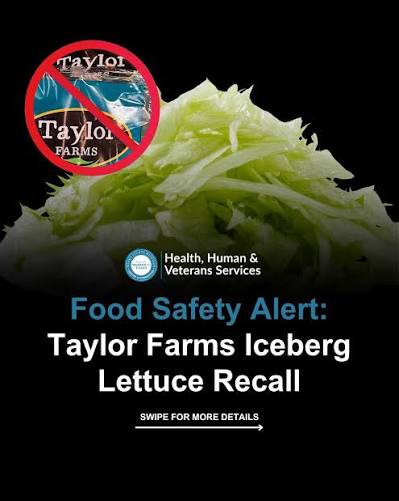
This summer, a Cyclospora outbreak linked to iceberg lettuce sickened almost 13,000 people in 21 states, killing two. Investigators traced the illnesses to lettuce supplied by Taylor Farms de Mexico, but the FDA closed its investigation on October 2 without determining how the food became contaminated, leaving questions about how to prevent similar outbreaks in the future.
A new Consumer Reports analysis of the oversight fiasco is damning: It documents conflicting agency updates, confusing recall notices, delays in obtaining supply-chain records, and the delayed enforcement of the FDA's Food Traceability Rule, which cannot be enforced for another two years.
Compounding the problem is the weakening of long-term disease surveillance. In July 2025, nearly a year before this outbreak, the Centers for Disease Control and Prevention made FoodNet reporting for Cyclospora and six other pathogens optional. That cut back a critical source of trend data amid broader reductions in federal public-health capacity
Together, the changes expose weaknesses in the U.S. food-safety system in two areas: supply-chain traceability and public-health surveillance.
The reduction in reporting did not appear to hinder the immediate investigation; the CDC maintains that the program tracks long-term trends, not individual outbreaks. But less required reporting makes it harder to see whether these illnesses are becoming more common. This comes at a time when the federal government is significantly reducing broader food-safety oversight. And federal cuts to CDC staff and grants put additional pressure on the people and programs needed to investigate future outbreaks. With recent cuts to food safety regulators, the food industry and restaurants will be hard-pressed to keep their supply chains safe.
Food safety status report
Restoring gold standard science. Implementing radical transparency. Making America healthy again.
While these slogans are all worthy goals for science and healthcare under the current administration, they are difficult to reconcile with the staffing reductions, funding disruptions, and restructuring plans affecting federal public health agencies overseen by Robert F. Kennedy Jr.
In March 2025, the Department of Health and Human Services (HHS) announced a reorganization and began reducing its workforce, with a goal of 10,000 layoffs. HHS also proposed creating a new Administration for a Healthy America (AHA). Congress later declined to fund that proposal in its FY2026 appropriations, but reductions in CDC staff continued, nonetheless.
The administration does not track the health effects of staffing and funding disruptions, so we have no hard numbers. Still, there is little doubt that at least some illnesses or deaths resulted from these cutbacks. Unless our public health infrastructure is strengthened, continued cuts will further erode the agencies' ability to detect and respond to health threats.
Mis- and disinformation are distorting science and public policy. Subscribe to our Daily and Weekly Digests for incisive coverage of 'disruptive' innovations in AI, agricultural biotechnology, food, chemicals, nuclear energy, vaccines, and other disruptive innovations.\
How dire is the crisis?
The latest funding figures, disclosed last spring, sharpen concerns. Congress provided $9.227 billion for CDC's core public health programs in FY2026, a 0.2 percent decrease from FY2025, and rejected many of the administration's proposed cuts. Yet CDC employment fell about 28 percent between the end of FY2024 and May 2026. That is a net headcount decline — including firings and resignations from those who could not stomach the politicization of the department. A recent analysis of CMS data estimates that governmental public health activities accounted for about 3 percent of the nation's $5.28 trillion in health expenditures in 2024.
Grant reliability is another part of the story. In January 2026, HHS briefly paused the roughly $5 billion Public Health Infrastructure Grant, then rescinded the pause about 12 hours later; state and local departments had already scrambled to assess the effect.
By May, HHS had terminated 444 CDC grants representing $5.78 billion in unliquidated obligations — funds committed to grants but not yet paid out. Separately, courts blocked the administration's planned termination of more than $600 million in CDC grants to California, Colorado, Illinois, and Minnesota, while litigation proceeded.
The FY2026 appropriations law added notice requirements for grant terminations and CDC reorganizations, as well as a mandate that HHS maintain staffing sufficient to carry out its statutory responsibilities.
States are being forced to find other creative ways to maintain public health programs. That includes funding systems to strengthen disease monitoring, expand syndromic surveillance, and manage immunization information systems across state and local agencies — often without federal platforms or support.
By bringing together real-time data from multiple sources, these tools can help health departments spot worrisome trends, target interventions, protect communities, save lives, and potentially reduce taxpayer costs. Examples include California Syndromic Surveillance (CALSYS) and Johns Hopkins University's Electronic Surveillance System for the Early Notification of Community-based Epidemics (ESSENCE), which help officials analyze, visualize, and track emerging public health threats so they can respond more quickly.
Universities strain to bridge the funding and innovation gap
As federal support for disease tracking and response recedes and data streams are cut back, some universities are trying to fill in the gaps.
O The University of Minnesota rolled out plans for an information hub at the Center for Infectious Disease Research and Policy (CIDRAP) in July 2025 to serve as a public clearinghouse for trusted information about infectious diseases, outbreaks, and vaccines. Last June, leveraging foundation grants, CIDRAP's Vaccine Integrity Project and The Evidence Collective announced complementary projects: independent vaccine review, governance, and public trust initiatives — work that might previously have received federal seed funding.
O Cornell, in response to the burgeoning bird flu crisis, and aware of waning government oversight, has significantly expanded its bird-flu resource center launched in 2025, adding an interactive dashboard and public guidance.
O Brown's Pandemic Center Tracking Report was expanded in 2025 after federal data streams were scaled back or altered, adding state and local reports for its team to aggregate and interpret.
O Fordham's Tick Index became a more prominent local guide during the high-risk seasons of 2025 and 2026, reaching warning levels of 10 out of 10 in 2025 and 9 out of 10 by this summer.

These tools can help fill information gaps, but they cannot replace sustained government surveillance or the specialized workforce needed to verify signals and respond.
The international surveillance network is also at risk. HHS announced last January that the United States had completed its withdrawal from the World Health Organization. Although the formal status of the withdrawal has not been officially resolved, the U.S. has stopped participating in WHO committees and technical groups.

Public-health experts warn that this could reduce access to shared information on infectious disease outbreaks. Facing intense global criticism, the U.S. announced the signing of bilateral health agreements with 36 countries, but rollout has faced delays. Whether these agreements can provide the reach of a global surveillance network the U.S. is determined to dismantle remains an open question.
While these are all important efforts, the impacts of the devastating cuts to federal funding — and the consequent job losses and program reductions — will be felt for years to come. Although underinvestment in public health is not new, the United States nevertheless achieved some impressive public health victories. The key to these successes has always been a commitment to evidence-based policy and investment in technology and tools that empower local leaders and public health officials to identify and respond to emerging threats.
To improve Americans' quality of life, extend life expectancy, and avoid even higher health-care costs, the federal government must recognize the serious need to invest in — not weaken — the nation's public health infrastructure.
Until the federal government expands funding for public health measures, state and local governments will be forced to find funding where they can. Only by investing in and exploiting a range of partnerships and technologies can state and local health departments respond to emerging public health threats even in the absence of federal support. Although not an ideal solution, it is the only option we have until the federal government renews its commitment to public health at the local, state and national levels.
Henry I. Miller is a physician and molecular biologist and the Glenn Swogger Distinguished Scholar at the Science Literacy Project. A veteran of the NIH and FDA, he was the founding director of the FDA's Office of Biotechnology. Find Henry on X @henryimiller
Jon Entine is the Executive Director of the Science Literacy Project. Find Jon X @JonEntine